
Atte: Lic. Clara Brugada
“Cities are beautiful because they are created slowly; they are made by time. A city is born from a tangle of monuments and infrastructures, culture, history and everyday stories" Renzo Piano

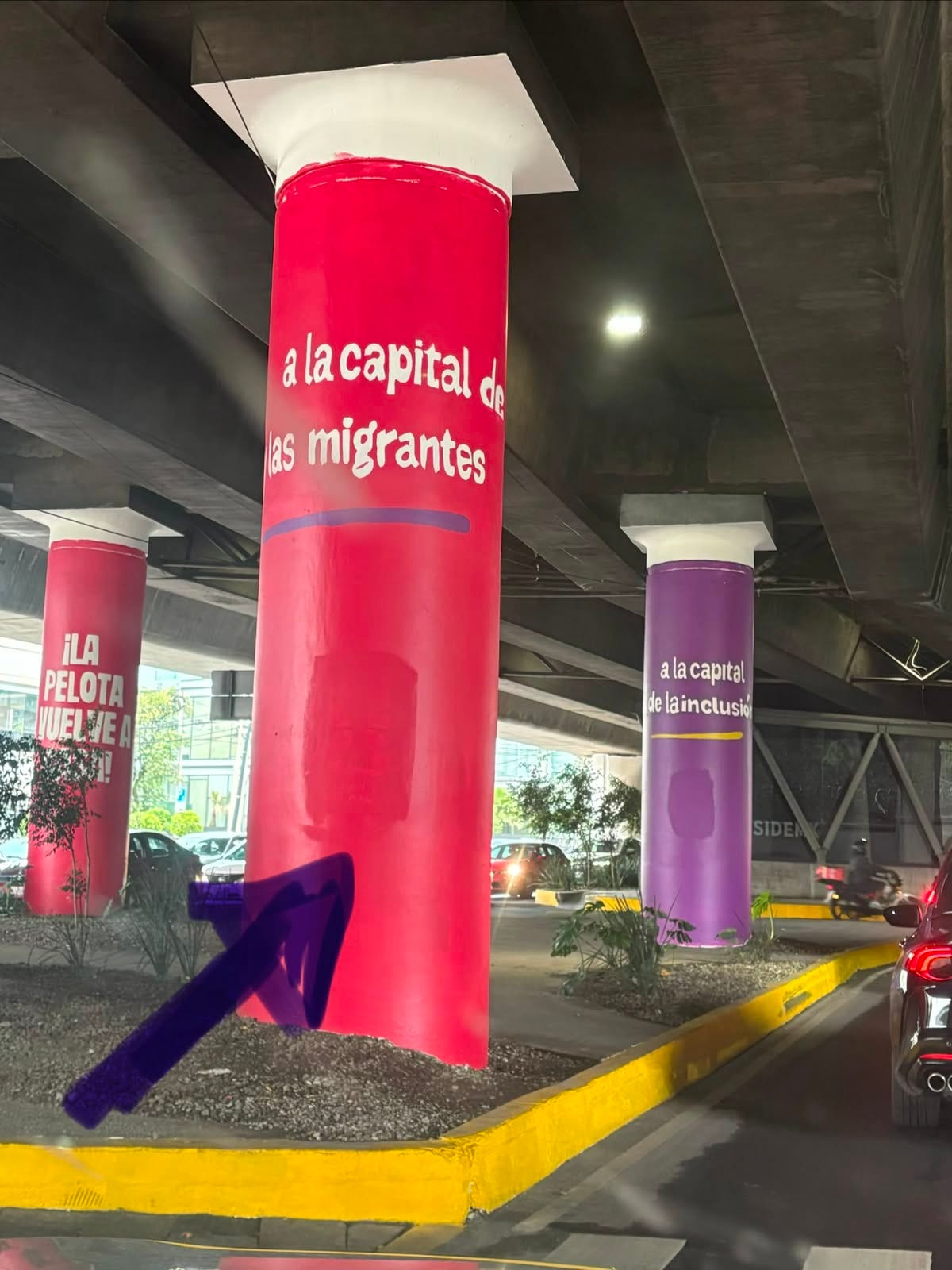
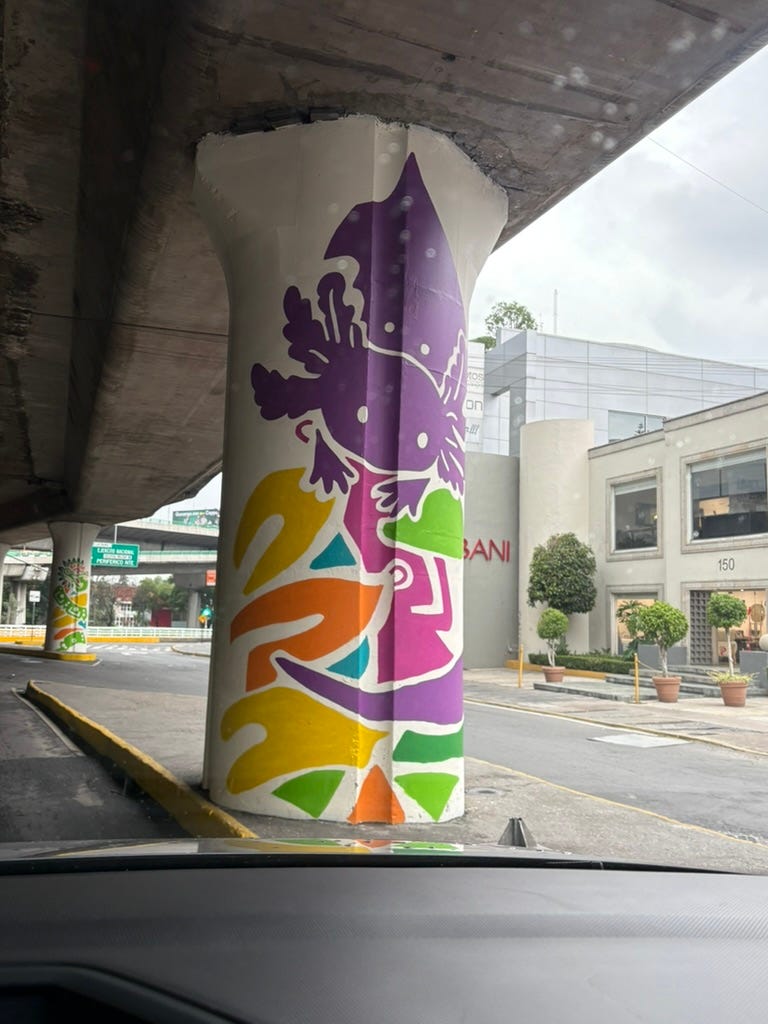
Todo el mundo va por la vida pensando que tiene buen gusto.
Eso es un hecho.
Lamentablemente, no siempre es así, pero eso es lo de menos, siempre y cuando cada quien haga lo que quiera con su casa, con su cuerpo, con su pelo y con su cara. El problema empieza cuando el mal gusto de una sola persona se impone sobre un espacio compartido por millones, y más aún cuando esa persona resulta ser la Jefa de Gobierno de nuestra ciudad.
Qué vergüenza, Lic. Clara Brugada.
Llevo semanas haciendo unos corajes brutales con sus ajolotes, su paleta de colores y sus rótulos mal hechos. Tan mal hechos, que ya estaba yo por reportarlos con la FIFA. Porque si algo sabemos de la FIFA es que tiene más regulaciones para el uso de su identidad visual que una farmacéutica para lanzar un medicamento. Y se ve que alguien le pasó el pitazo, porque ya vi que mandaron pintar encima de varios de los lugares donde aparecían. ¿Cuántas metidas de pata más? ¿Cuánta pintura más? ¿Cuánta mano de obra, cuánto presupuesto y cuánto tiempo piensa invertir en sus ocurrencias propagandísticas?
Es que no sé si lo sepa, Lic. Brugada, pero México es un país que le ha regalado al mundo arquitectos, diseñadores, artistas, fotógrafos, interioristas, cineastas, cocineros y creativos capaces de competir con cualquiera. Somos un país que exporta talento. Un país que durante décadas ha construido una identidad contemporánea admirada en todo el mundo.
Basta caminar por esta ciudad para entender que aquí habitan miles de personas dedicadas a pensar cómo vivimos mejor el espacio, cómo dialogan la tradición y la modernidad y cómo se construye una ciudad tan impresionante como la nuestra.
Pero desde que llegó la 4T, alguien apretó el botón de reversa y nomás no lo suelta.
Lo que sí me impacta es que la Señora Presidenta le haya dado carta abierta a esta visión “tan suya” de ciudad, sobre todo porque tiene poco que ver con las necesidades reales de quienes la habitamos, pero mucho que ver con la construcción de su narrativa política personal.
Cuando el espacio público deja de diseñarse para los ciudadanos y empieza a utilizarse como vehículo de una ideología, entramos en terreno peligroso. Las calles, los parques, las plazas y los puentes nos pertenecen a todos. La identidad de una ciudad tan compleja como la Ciudad de México no puede reducirse a una sola manera de contarse. Nuestra ciudad no tiene una historia, tiene miles. No tiene un solo símbolo, tiene miles. No tiene un solo color, tiene miles.
Las grandes ciudades del mundo son especiales precisamente porque son contradictorias. Porque en ellas conviven distintas capas de historia, de arquitectura, de cultura y de pensamiento. Por eso me enfurece ver sus códigos visuales repetidos por todos lados, ocupando cada esquina, neceando con un lenguaje gráfico mal ejecutado, con el mismo morado, con los mismos mensajes.
A veces me pregunto quién la estará asesorando visualmente, y luego pienso que quizás es mejor no saberlo. Aquí tenemos diseñadores y artistas que exponen en los museos más importantes, mentes capaces de transformar cualquier espacio, pero aun así, pareciera que para intervenir la ciudad, se privilegia a quienes están dispuestos a decirle a usted que sí, antes que a quienes sabrían hacerlo mejor.
Entonces, mientras el mundo entero voltea a ver a México por su diseño, por su gastronomía, por su arquitectura y por el talento de su gente, nosotros estamos teniendo una conversación cada vez más diminuta y estéril, sobre cómo pintar barandales y banquetas.
Y es que de verdad, Licenciada, me jode mucho su renuncia a lo bello.
Porque la belleza no es frivolidad.
La belleza comunica.
La belleza inspira.
La belleza genera orgullo.
Y la belleza construye ciudades que la gente quiere cuidar.
Lic. Brugada, usted debió ponerse a ajolotizar su casa y su oficina. No debió pintarrajear nuestra ciudad.
Arregle los baches.
Arregle el Metro.
Métale mano a la infraestructura de la Ciudad de México.
Ilumine las calles.
Y deje los crayones en el cajón, junto con el rebranding de su gobierno.
La Ciudad de México ya tenía identidad antes de usted y la seguirá teniendo después de usted. Lo que claramente no sabemos, es si quienes la gobiernan están a la altura de ella.
Porque gobernar una ciudad como la nuestra, implica también entenderla, respetarla y cuidarla. No convertirla en una extensión de su marca personal.
Lo que más coraje me da no es el morado, no es el ajolote, no son los rótulos mal hechos, sino la oportunidad perdida.
La oportunidad de haber dejado una ciudad más bella, más digna y más admirable de la que usted recibió.
Porque los gobiernos pasan.
Eso que ni que,
Usted se irá.
Pero la ciudad se queda.
(y menos mal que la pintaremos de nuevo).
IN ENGLISH:
Everyone goes through life convinced they have good taste.
That much is a fact.
Unfortunately, that is not always the case. But that would hardly matter if people confined their questionable choices to their own homes, their own bodies, their own hair, and their own faces. The problem begins when one person’s bad taste is imposed on a space shared by millions—especially when that person happens to be the Head of Government of our city.
What a disgrace, Ms. Clara Brugada.
For weeks now, I have been grinding my teeth over your axolotls, your color palette, and your poorly executed signage. So poorly executed, in fact, that I was half tempted to report it all to FIFA. Because if there is one thing we know about FIFA, it is that they have more rules governing the use of their visual identity than a pharmaceutical company has for launching a new drug. And it seems someone must have tipped you off, because I have already noticed that several of those installations have quietly been painted over. How many more missteps? How much more paint? How much more labor, budget, and public money do you intend to spend on these propagandistic whims?
I don’t know whether you realize it, Ms. Brugada, but Mexico is a country that has given the world architects, designers, artists, photographers, interior designers, filmmakers, chefs, and creative minds capable of competing with anyone, anywhere. We are a country that exports talent. A country that, for decades, has built a contemporary cultural identity admired around the globe.
All it takes is a walk through this city to understand that thousands of people here devote their lives to thinking about how we inhabit space, how tradition and modernity can coexist, and how a city as extraordinary as ours should be shaped.
Yet ever since the Fourth Transformation arrived, someone seems to have hit the reverse button—and they simply refuse to let go.
What truly astonishes me is that the President has given free rein to this deeply personal vision of the city, a vision that appears to have little to do with the real needs of those who live here and far more to do with the construction of a political narrative.
When public space stops being designed for citizens and begins to function as a vehicle for ideology, we enter dangerous territory. Streets, parks, plazas, and bridges belong to all of us. The identity of a city as complex as Mexico City cannot be reduced to a single narrative. Our city does not have one story—it has thousands. It does not have one symbol—it has thousands. It does not have one color—it has thousands.
The world’s great cities are remarkable precisely because they are contradictory. Because within them coexist different layers of history, architecture, culture, and thought.
That is why it infuriates me to see the same visual codes repeated everywhere, occupying every corner, insisting on the same poorly executed graphic language, the same purple, the same messages.
Sometimes I wonder who is advising you on these visual decisions. Then I think perhaps it is better not to know.
This country is home to designers and artists whose work hangs in the world’s most important museums, minds capable of transforming any space. And yet, when it comes to reshaping the city, it seems those willing to tell you “yes” are valued more highly than those who might actually know how to do it better.
So while the world looks to Mexico for its design, its gastronomy, its architecture, its creative industries, and the extraordinary talent of its people, we find ourselves trapped in an increasingly small and sterile conversation about how to paint railings and sidewalks.
And the truth is, Ms. Brugada, what bothers me most is your abandonment of beauty.
Because beauty is not frivolous.
Beauty communicates.
Beauty inspires.
Beauty creates pride.
And beauty builds cities that people want to care for.
Ms. Brugada, you should have focused on “axolotlizing” your home and your office.
You should not have painted over an entire city.
Fix the potholes.
Fix the Metro.
Invest in the infrastructure of Mexico City.
Light the streets.
And leave the crayons in the drawer along with your government’s rebranding exercise.
Mexico City had an identity long before you arrived, and it will continue to have one long after you are gone. What remains uncertain is whether those who govern it are capable of rising to its level.
Because governing a city like ours also means understanding it, respecting it, and caring for it—not turning it into an extension of a personal brand.
And what angers me most is not the purple.
Not the axolotl.
Not the poorly executed signs.
It is the missed opportunity.
The opportunity to leave behind a city more beautiful, more dignified, and more admirable than the one you inherited.
Because governments come and go.
That much is certain.
You will leave.
But the city will remain.
(and thankfully we will paint it again).